
Gut · Heart · Brain
The Art of Not Planning: How I Stock a Kitchen for Gut Health
I don’t really like meal planning.
Ask me on Sunday what I want to eat next Thursday and chances are that by Thursday I won’t fancy it anymore. But oddly, I don’t mind eating similar things quite regularly. I think the difference for me is having a choice.
So instead of planning meals, I’ve gradually built up a set of gut health kitchen staples, so the kitchen is nearly always ready to make something. I don’t necessarily know what that something will be until I’m hungry.
And that works much better for me.
The fridge
There is nearly always kimchi, sauerkraut, kefir and Greek yoghurt.
We’ve moved to zero-fat Greek yoghurt because of cholesterol considerations in the family, although if I’m truthful, I’m mostly interested in it because it’s an easy way of getting some extra protein.
There are berries, cheese and butter, although I rarely use much butter myself because extra virgin olive oil generally wins.
Mushrooms are another staple. Mushrooms on a good seeded bread is one of my favourite light suppers when I really can’t be bothered to make anything more elaborate.
And tofu lives in the fridge too, more in hope than regular use.
Bananas and apples tend to live on the table rather than in the fridge.
We have a slightly ridiculous selection of nuts, homemade granola and whatever herbs are doing well in the garden. Sage, rosemary, mint and marjoram are the usual ones.
The important bit for me is that I don’t have to think too hard when I’m hungry. I can open the fridge, put several things together and eat.
My version of meal planning
There is actually some organisation behind it, despite my resistance to calling it a plan.
In the cupboard there are always tinned fish and beans. Quite a range of beans usually, so there is always protein and something plant-based I can add to a meal without much effort. We also always have Pimhill oats, which are hands down the best quality we’ve found.
In the freezer I keep peas, sweetcorn and edamame. Nothing exciting, but incredibly useful and ready in minutes.
Then I tend to have a few things already cooked.
Usually there’s a mixed grain pot of bulgur wheat, pearl barley and red and white quinoa, although sometimes I’ll cook one grain on its own. I’ll also cook a big batch of vegetables, often broccoli, carrots and sweet potato.
That means if I’m tired or busy, I’ve already got most of a meal sitting there.
Sometimes I’ll make a complete main dish with lots of flavour, usually something Italian, Thai or Indian, and we’ll eat from that over a few days. Other times I’ll cook a chicken or duck fairly plainly and decide what I’m doing with it later.
There are five of us, so this is what has evolved to work in our house. For one or two people you could obviously make it much simpler.
The gut-health bit happened almost by accident
I didn’t start doing this because somebody told me it was the right way to eat for my gut. I did it because it suited me and made eating well easier.
It was afterwards that I became interested in how closely some of it matched what we were learning about the gut microbiome.
One of the things that particularly interested me was plant diversity.
Research including the American Gut Project found an association between eating 30 or more different plant foods a week and greater gut microbial diversity. More recent work from ZOE and King’s College London went further, looking at whether the variety of plants we eat matters independently of simply eating more of them, and found that it does: diversity itself appeared to influence gut bacteria, not just the overall quantity of plants on the plate.
That’s interesting to me because I don’t want to sit there counting 30 plants every week.
I’d much rather buy a different tin of beans, use barley instead of quinoa, throw some edamame into something, pick some herbs from the garden and find I’ve accumulated a decent variety without turning eating into another job.
The same goes for fermented food.
We usually have kefir, kimchi and sauerkraut rather than relying on one fermented food all the time. Research from Stanford has found increased microbiome diversity and reduced markers of inflammation in people eating a diet high in fermented foods.
I find that fascinating because these are quite small things to have sitting in the fridge. A spoonful of kimchi with dinner or kefir at breakfast doesn’t feel like a major health intervention. It’s simply food.
Where we buy things
We use Riverford or buy locally when we can, and Sainsbury’s organic when we can’t.
We keep chickens, and although their feed isn’t completely organic, their eggs are some of the best things we have in the house.
I used to have a vegetable plot too. I haven’t managed to keep it going and, yes, it does nag at me slightly whenever I walk past it.
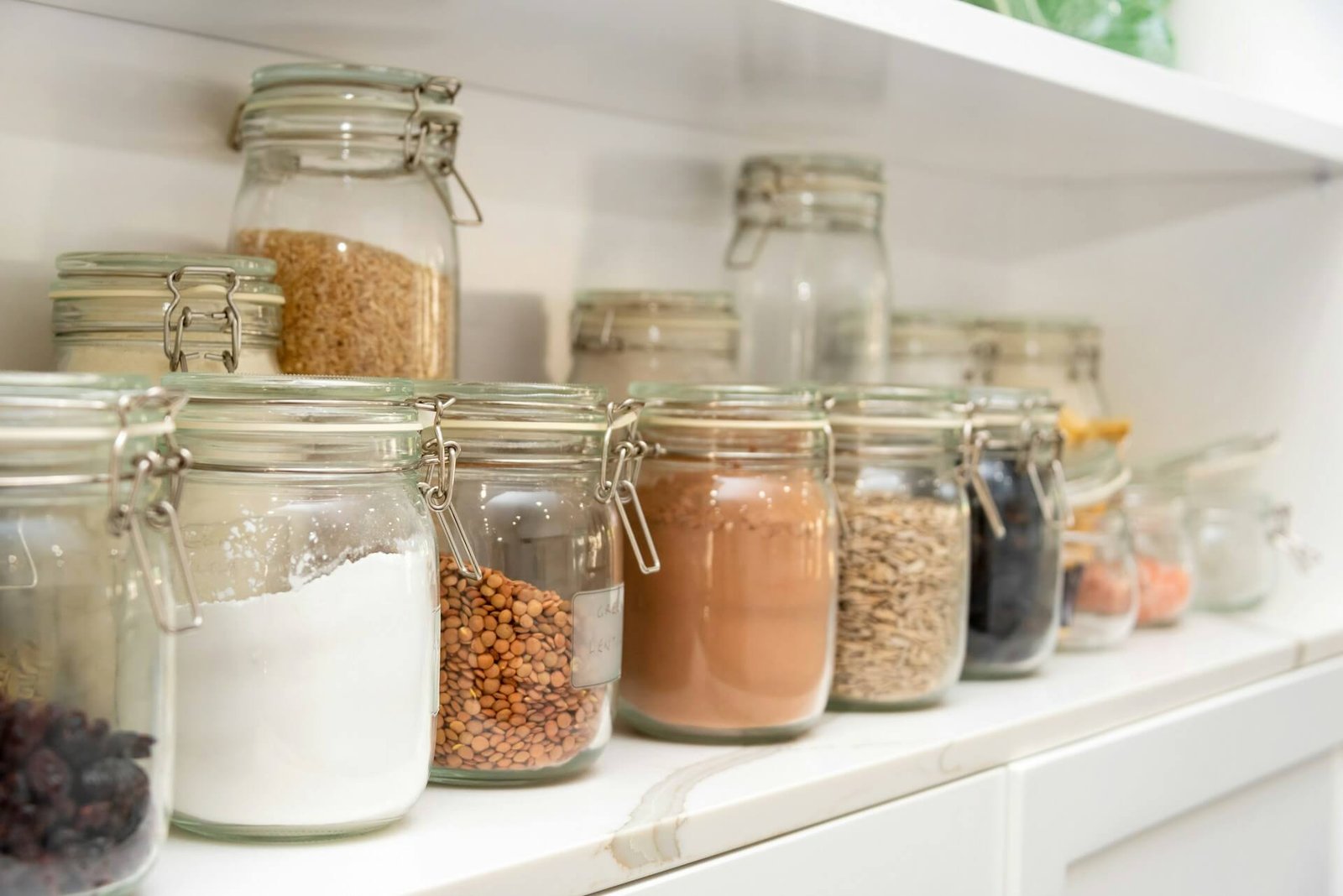
We’ve gradually moved most of our food storage from plastic to glass.
We grind coffee beans every morning and I have black coffee. That is one of the few things I do remarkably consistently.
With sugar, I tend not to use much and will usually choose maple syrup or agave instead. The rest of the family uses local honey too, and we’ve even experimented with fermenting garlic in honey.
Salt is Maldon. Pepper comes out of a grinder.
We’ve also recently started buying some raw milk.
I’m not going to pretend I’m completely relaxed about it. I’ve read enough of the negative press that there’s still a tiny flicker of anxiety when I drink it. But I also really like it. It’s sweet and has far more flavour than I expected.
That’s one of those choices that is working for us, not something I’m suggesting everybody else should do. Raw milk carries genuine food-safety risks which pasteurisation is designed to remove, so it’s something to understand properly before deciding for yourself.
And we certainly haven’t abandoned everything else. There’s usually oat milk, unsweetened soya milk and organic pasteurised milk in the house as well.
Tea has almost become a category of its own: matcha, various fruit teas and ordinary breakfast tea for when that’s what I actually want.
Things I haven’t cracked
Sauces.
Ketchup and mayonnaise are still sitting firmly in the fridge door.
I’d personally rather add a pickle, capers, raw onion or tomato than squeeze sauce over something, and that has the added advantage of sneaking another plant onto the plate.
But I live with other people.
I’m still looking for genuinely good alternatives that don’t feel as though you’re eating the worthy version simply because it’s supposed to be healthier.
Bread has been another saga.
We used to buy LiveLife, which was easily the best loaf we’d found, and then it disappeared from Co-op and Waitrose. I’ve no idea why.
The best replacement I’ve found so far is Sainsbury’s Taste the Difference white sunflower and pumpkin seed farmhouse loaf. It means mushrooms on toast can still count as a proper supper in my book.
And surprisingly, we don’t waste much
You might think having this much food prepared would lead to waste, but generally it doesn’t.
We’re not perfect, but we’re pretty good at using things up and we don’t automatically throw something away because of the date printed on the packet. We look at it, smell it and make a judgement.
And if something really has gone past the point where we’re prepared to eat it, there are usually some very grateful chickens or other animals waiting.
So what do I actually do?
I don’t count plants obsessively. I notice variety.
If I used one bean last week, I might buy another one this week. I vary the grains. I add nuts, seeds, herbs and berries. Some days there will be loads of different plants on a plate and other days there won’t.
I have kefir most mornings and usually some kimchi or sauerkraut with a main meal.
I batch cook because I know myself well enough: if I’m tired and there’s nothing ready, I’m far less likely to make a good meal from scratch.
And that’s really the whole point.
This isn’t about being disciplined or having a perfect kitchen.
It’s about knowing what I’m like.
If good food is already there when I’m hungry, I’ll eat it. If I’ve got to start thinking, planning and chopping everything from scratch at six o’clock on a busy Tuesday, there’s a considerably greater chance I won’t.
So I don’t meal plan.
I suppose I ingredient plan.
And for me, that seems to work.
Further reading & sources
- Berry, S. et al., ZOE BIOME study, British Journal of Nutrition (2026)
- McDonald, D. et al., American Gut Project, mSystems
- Wastyk, H. et al., “Gut-microbiota-targeted diets modulate human immune status,” Cell (2021)
- com, “Best Fermented Foods for Gut Health: What Works” (2026)
This article is for education only and isn’t medical advice. We’re not medically qualified, and this reflects our own experience rather than a recommendation for anyone else. If you’re making significant dietary changes, particularly around raw dairy or fermented foods, speak to an appropriately qualified healthcare professional.